A REMEMBRANCE DAY STORY OF FORGIVENESS AND REDEMPTION
In memory of Tim Cook – Canada’s pre-eminent war historian
By Jonathon Reid

On July 22, 1993, Japan’s Asahi Evening News published a feature story about Masao Uwamori, a retired stockbroker, who during the Second World War was commandant of several Japanese prison camps that held hundreds of Canadian prisoners of war.
Asahi Evening News story about Masao Uwamori, July 1993

The story explained that after the war Uwamori was prosecuted by the Allies at the Yokohama War Crimes Trials for charges of “abusing prisoners and causing many of them to die,” and that Uwamori had been “prepared to be sentenced severely and was even resigned to being handed the death penalty.” But these serious charges had been untrue, and because of the intervention of a Canadian medical officer who had been interned in one of his camps Uwamori had received a suspended sentence and been set free:
Masao Uwamori in his 80s

”Thanks to his kind testimony, my sentence was reduced,” said Masao Uwamori. “I’m 89 years old. It’s nearly 50 years since then, and I believe the Canadian officer must be in his 70s by now. If I don’t contact him now, I may never be able to thank him.”
According to Uwamori, who was a former lieutenant in the Japanese Imperial Army, the name of the officer, who belonged to the Royal Canadian Army Medical Corps, is J.A.G. Reid. He is asking anyone who has information on the Canadian officer to contact him.
Captain John Reid, RCAMC, Ottawa 1941

Canadians arrive in Hong Kong, November 1941
Fifty years earlier, on January 29, 1943, Captain John Reid, a young Canadian doctor with only five weeks’ officer training, marched at the head of his troops – 511 soldiers of the Royal Rifles of Canada and the Winnipeg Grenadiers regiments – into Tokyo Prison Camp 3D, where Commandant Masao Uwamori and his squad of camp guards awaited them.
Reid and his men were survivors of the Battle of Hong Kong in which the British garrison, outnumbered five to one, had fought fiercely for 18 days before finally surrendering to the attacking Japanese on Christmas Day 1941, after tremendous losses. The two Canadian regiments, which had arrived to reinforce Hong Kong just weeks before the attack, lost 290 men killed, 493 wounded in the battle, a casualty rate of nearly 40 percent.
Through 1942, Reid and his fellow POWs had been interned in two deplorable prison camps in Hong Kong, where the men were forced to work as slave labourers. Ill-fed, ill-housed, and worked to the bone, the Canadians were soon suffering from dysentery, beriberi, pellagra, malaria, skin ulcers, and severe weight loss as lack of vitamins and malnutrition wore down the men’s resistance. In the second half of 1942 a rampant outbreak of diphtheria killed 58 Canadians because the Japanese withheld life-saving antitoxin.
It was from this beleaguered group of Canadian POWs that in January 1943 the Japanese selected a large contingent of men to be sent to Japan to work as slave labourers at the Nippon Kokan shipyard outside Yokohama. The Japanese said only one officer was to accompany the group and insisted he be one of the four Canadian medical officers, not a line officer. Reid drew the short straw. On January 19, 1943, he and his men boarded a ship to Japan, arriving at Commandant Uwamori’s camp 10 days later.
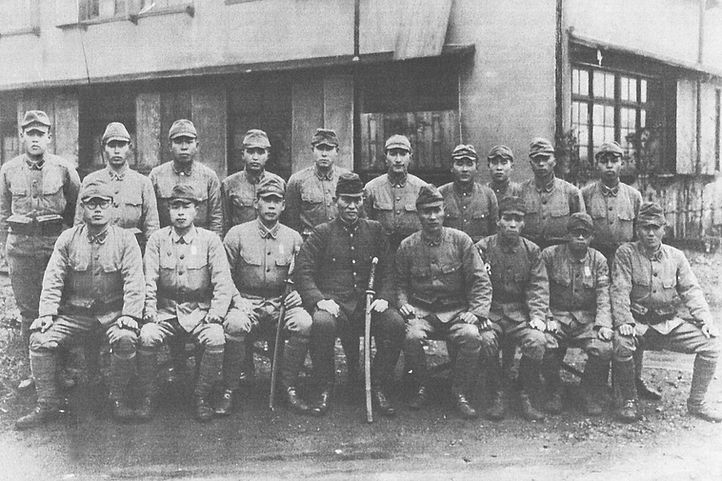
Japanese staff, Camp 3D, January 1943; Lieutenant Uwamori front row, centre
Here at Camp 3D the Canadian POWs were used as forced labour at the shipyard 12 hours a day, 13 days out of 14. The miseries they had suffered from malnutrition and overwork for 13 months in Hong Kong continued in Japan and were now compounded by a much colder climate.

Mug shots of Canadian POWs, Camp 3D, 1943
The miracle that Captain Reid performed over the next two and a half years was to stand up for his men against the harsh Japanese treatment. Deploying a shifting mixture of commonsense logic, determined argument and his considerable personal charm Reid gradually persuaded Commandant Uwamori to ease the suffering of the Canadians by allowing more sick days, easier workloads, and as time went on to help Reid get medicines, blankets and more food for his men.
Reid always maintained that the Allies would win the war – to his men and to Uwamori as well – and after a guard’s savage beating of a Canadian prisoner in the spring of 1944 Reid warned the commandant in a stiffly worded letter that there would be severe postwar consequences for such behaviour. All beatings in the camp came to an end. Reid’s working relationship with Uwamori became so successful the Japanese authorities removed Uwamori from command of Camp 3D in February 1945 for being too soft on the Canadian prisoners.

Canadian POWs, after the Japanese surrender, August 1945

Captain Reid, August 1945
After the Japanese surrender in August 1945, Reid wrote a letter of commendation to Uwamori to be used as a shield from possible prosecution as a war criminal. In the spring of 1946, eight months after his repatriation to Canada, Reid learned that Uwamori had nevertheless been charged with war crimes, prompting Reid to submit an affidavit to the War Crimes Section of the Department of National Defence in Ottawa outlining Uwamori’s humane response to the plight of Reid and his men during their years in Camp 3D. Reid’s main argument was that, over time, Uwamori had responded to Reid’s persuasions, and within the constraints of Japanese hierarchy had done the best he could for the Canadian prisoners.
This intervention failed to persuade the Yokohama War Crimes Tribunal and Uwamori was sent to trial in April 1947. On learning the trial was proceeding, Reid was furious. He wrote another affidavit in Uwamori’s defense, and had it transmitted to the Military Commission in Yokohama where it arrived, mid-trial. In this second affidavit, Reid hammered home detail after detail of Uwamori’s positive behaviour before concluding:
I could go on recalling incidents for some time, but I feel that these give you the skeleton of the man. Such a state of cooperation was of course not obtained overnight. It took several months of constant effort, largely on my part, to establish such a frame of mind in Lieutenant Uwamori. But several decades of such efforts would not have established it in other Japanese Commandants I have known.
One must also consider that Lieutenant Uwamori was a Japanese propagandized to feel that we were the bitter and treacherous enemies of Japan; that he had never been in a western civilization; that he was an officer in the Japanese Army, acting under orders that were certainly not favourable to us as prisoners, and that physical punishment, drumhead justice, semi-starvation, the inadequate care of the sick, and the lack of dignity and the value of the individual were not only part and parcel of his army’s organization and philosophy, but of the life of his whole country, in order to understand that he required personal qualities of fairness and consideration to be so far won over by any means.
To sum up, I did not observe any actions under the circumstances for which I feel Lieutenant Uwamori should be punished as a war criminal.
In giving his summation at the end of the trial, Ira Kaye, Uwamori’s court-appointed American defense counsel, gave Reid the last word: “The opinion of Major Reid is so superlative and lengthy that no quotation from his affidavits and letters is necessary. To him, Uwamori was an outstanding exponent of humanitarianism.”
Masao Uwamori was given a suspended sentence and set free. A year later, a carefully hand-written letter arrived in Toronto:

1st December 1948
Major Reid
Dear sir,
I have learned through your affidavit that you are well and still very sympathetic and warm-hearted toward me. My lawyer Mr. Kaye has kindly offered to have this letter sent to you. I think I had better write down the events in detail which happened so far.
In December 1946 I was charged with violation of the Laws and Customs of War. The charges and specifications were the biggest ones which the defence section ever handled – the latter were more than eighty. I was quite at a loss without knowing what to do.
However, my lawyer did his utmost to defend me. He pried into all affidavits and concluded that you would be the life saver for me, because you were deemed the fairest and most humane person he ever came in contact with through all the documents at the Yokohama trials.
On 16th April 1947, I was able to face the trial with a light spirit and an excellent health expecting your favoured statement. To my great joy, as was expected, you sent a wonderful disposition on my behalf just in due time during the trial. One thing that delighted me was that you stated so many concrete evidences to enable the Commission to appreciate the estimate of me, analysing (sic) not only the Japanese Army’s organization but also the life of my whole country.
Thus, to sum up, you praised me by saying I had most un-Japanese personal qualities of fairness. Your letter and affidavits were introduced at the final argument by my lawyer and they put the court into a surprising move.
On April 28th, I was sentenced to three years hard labour, but having weighed the mitigating factors – my humane treatment of Allied prisoners of war – the Commission made the recommendation for clemency to the Convening Authority. At last, I was released from the prison and could be a free man under a suspended sentence.
How can I express the greatest joy I ever felt in my life. Arrived home in the evening of the big day. I was welcomed by my family and could not help hugging each other and shedding tears. I think I could imagine your deep emotion which you have felt when you came home after the war.
It was entirely of your favour to enable me to get rid of such a very hard case. I hereby explain my sincerest gratitude for your fairness and kindness to me during and after the war.
My eager hope now is that I could use my person and capabilities for the benefit of the Allies and Japan during the formative years that lie immediately ahead as the Military Commission recommended, and I believe it might be the best compensation for the hardships from which you and your men suffered in my camp and also might be a small gift to you which would please you to a certain extent.
Never would I forget your efforts, kindness and fairness as long as I live.
Yours respectfully,
Masao Uwamori
In July 1993, Naoaki Kobayashi, who as young man had been a court interpreter at the Yokohama War Crime Trials, happened to read the feature story about Masao Uwamori in the Asahi Evening News. He telephoned Uwamori and offered to help find Reid. It was not to be. After searching for some months, Kobayashi learned through the Hong Kong Veterans Commemorative Association in Canada that Dr. John Reid had died of pneumonia and war-related health issues in 1979, 14 years earlier. When Masao Uwamori got the news, he wrote Kobayashi the following letter:
February 14th 1994
Dear Mr. Naoaki C. Kobayashi
Many thanks for your kindness. I can see you must have gone through a great deal of effort to find out about Captain Reid, who had become one of my closest friends when we were working together in a POW camp during the last war, despite we were both enemies, against each other.
I was dazed when I learned that he had died at the age of 65. Closing my eyes, I still see him as a nice and gentle man, and yet a man of high calibre, with confidence and sincerity, who as an officer of the Canadian Army devoted himself to the sake of several hundred men under him.
I vividly remember the time when we met each other for the first time in January 1943. It was in a courtyard of the POW detached camp at Tsurumi, where all the POWs were assembled.
Standing in the middle, in front of the lines of his Canadian men, he commanded – “Attention!” – strong and loud and gave me his first salute.

Epilogue
The death rate of prisoners of war of the Japanese in Japan and the Japanese occupied territories during the Second World War was 29 percent. The death rate of Canadian POWs in Japanese prison camps other than Reid’s was over 16 percent.
In Reid’s camp, the death rate was 4 and a half percent – a testament to Reid’s leadership, persuasiveness, and medical care, and Uwamori’s gradual acquiescence to Reid’s influence during the years that the war bound the two men together.
This article is adapted from The Captain Was a Doctor, published by Dundurn Press.